The University of La Laguna (ULL) closed this week the 2025 edition of the course “Science, nutrition and heritage: Exploring the wines of the Canary Islands”, a training proposal that has focused on scientific dissemination and practical knowledge of wine as an agri-food, cultural and territorial product. The activity took place at the Faculty of Pharmacy and was part of the University Extension Courses programme “Training to grow”, promoted by the Vice-Rectorate for Culture and University Extension.
The course was coordinated by the Chair of Agrotourism and Wine Tourism of the Canary Islands, a joint initiative of the Canary Islands Institute of Agri-food Quality and the ULL itself, with the aim of transferring academic knowledge to society as a whole and reinforcing training in the wine sector of the archipelago.
A holistic approach: science, nutrition and territory
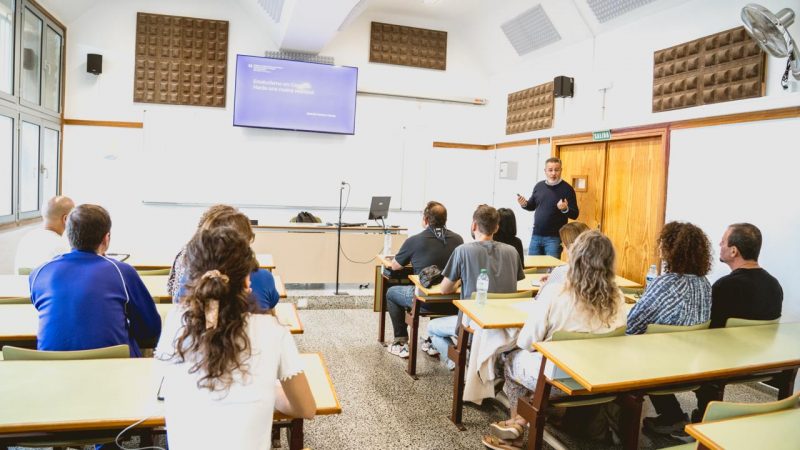
Aimed at both university students and those interested in the world of wine, the programme offered a global vision of Canary Island wine, combining scientific content, nutritional analysis and contextualisation of its heritage. Over the course of several sessions, participants delved into the composition of wine, analytical methods of quality control and the role of the vineyard in the cultural identity of the Canary Islands.
The training was structured through theoretical lectures, practical sessions and exchange spaces with professors and specialists from the academic field, favouring accessible learning without renouncing scientific rigour.
Wine tourism and new realities in the sector
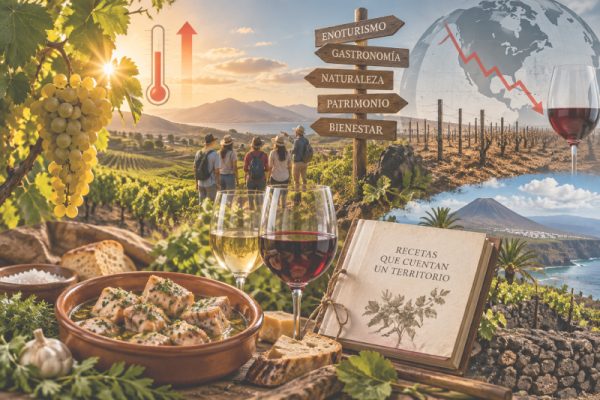
The inaugural session was given by Gabriel Santos García, general coordinator of the Chair of Agrotourism and Wine Tourism of the Canary Islands, with a talk entitled “Wine tourism in the Canary Islands. Towards a new reality”. In his speech he analysed the evolution of wine tourism in the islands, highlighting the growing interest in local production, sustainability and the connection between wine, landscape and tourist experience.
Santos underlined the challenges and opportunities facing the sector in a context of transformation of the tourism model, where wine is consolidating as a differentiating element of the territory.
Wine composition and analytical control
Professor of Nutrition and Bromatology Carlos Díaz Romero, member of the Advisory Board of the Chair, addressed the chemical composition and nutritional content of wine, focusing on the singularities of Canary Island varieties. His session provided an insight into the parameters that influence both the quality and the sensory perception of the final product.
In the field of technical analysis, Elena María Rodríguez Rodríguez, lecturer in the Department of Chemical Engineering and Pharmaceutical Technology, participated in the session dedicated to the analytical parameters of wine, given together with Jesús Enrique de las Heras Roger. This part of the course focused on the physico-chemical methodologies used to guarantee the quality, authenticity and traceability of Canary Island wines.
Vinification and sensory analysis
The academic coordination of the course was the responsibility of Jesús Enrique de las Heras Roger, director of the Chair of Agrotourism and Wine Tourism of the Canary Islands, who completed the training with contents applied to winemaking processes, quality controls in the winery and technical evaluation methods.
De las Heras also gave a session on the sensorial analysis of Canary Island wines, in which the participants were able to identify the characteristic organoleptic attributes of different Canary Island wines. On the course, he stressed that “understanding the science of wine is essential for valuing a product that combines tradition, research and territory, and for preserving the Canary Islands’ wine heritage”.
Technical visit to a reference winery
To close the programme, the course included a technical visit to the Winery Burgmann Tenerife, located in the Tacoronte-Acentejo Protected Designation of Origin. During the tour, the participants learned first-hand about the winemaking, management and quality control processes in a representative winery in the north of Tenerife, reinforcing the practical nature of the training.
With initiatives like this, the University of La Laguna and the Chair of Agrotourism and Wine Tourism of the Canary Islands consolidate their commitment to training that integrates science, culture and professional development, strengthening the connection between academia and the Canary Islands wine sector.