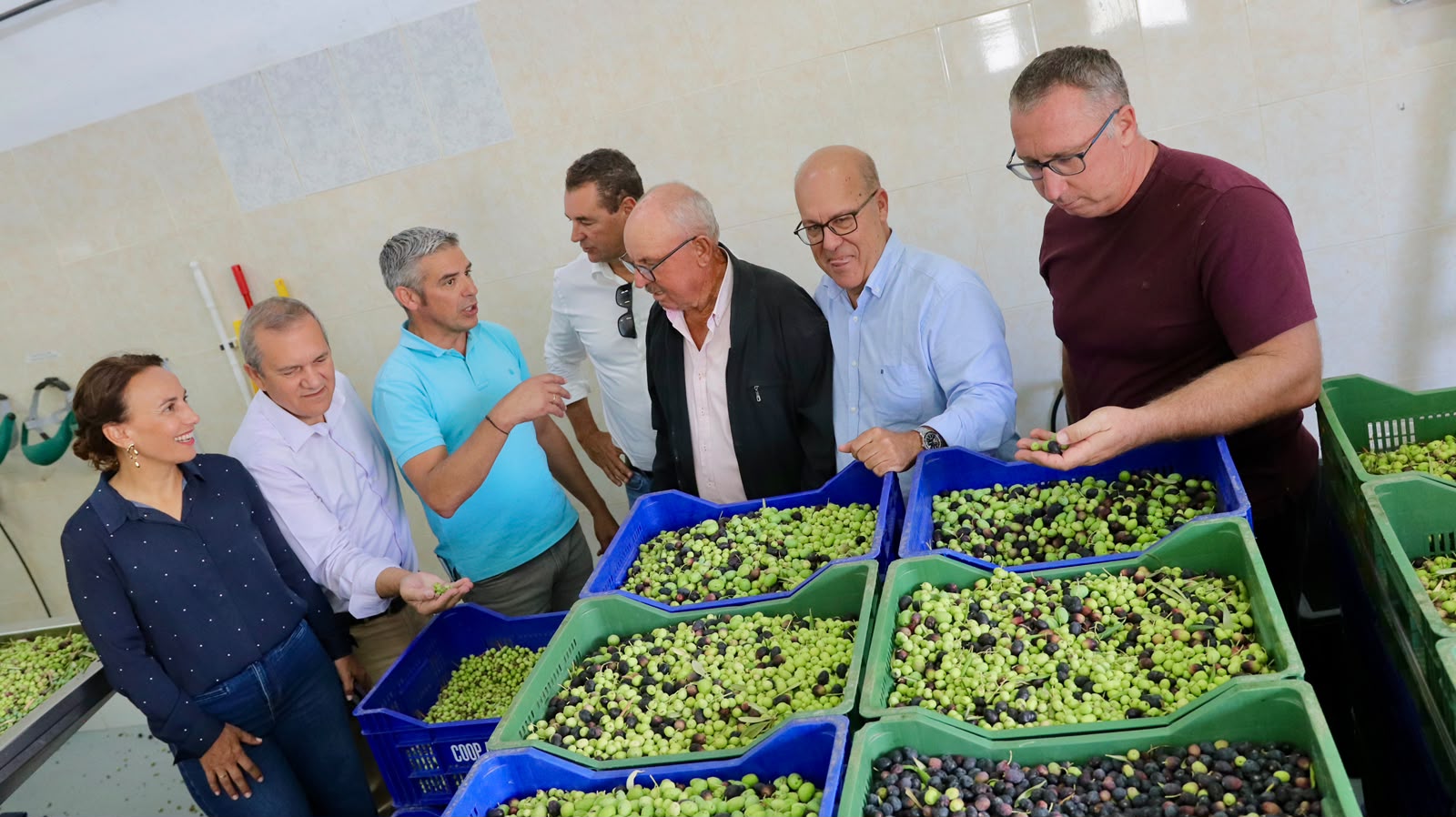
The Arico cooperative, a pioneer in olive cultivation in the Canary Islands, expects to harvest 200,000 kilos of olives this season. The Regional Minister for Agriculture, Narvay Quintero, visited the cooperative’s facilities to learn about the production of its extra virgin olive oils.
The Cumbres de Abona Co-operative is embarking on a new olive-harvesting season with a forecast yield of 200,000 kilos, a figure which, according to its chairman, Manolo Marrero, would represent a record harvest for the organisation. Since the start of the harvest on 17 August, approximately 100,000 kilos have been gathered.
Narvay Quintero, the Canary Islands Government’s Minister for Agriculture, Livestock, Fisheries and Food Sovereignty, visited the cooperative’s facilities in Arico on Wednesday 23 September to find out about the progress of the harvest and the production process for Oleoteide, its brand of extra virgin olive oil (EVOO).
Marrero attributed the promising outlook for the harvest to the rainfall recorded this year. He explained that around 15 per cent of the olives harvested will be used to produce Oleoteide, a range of oils which, he pointed out, usually sell out two or three months after they go on sale.
A co-operative that paved the way for the Canarian olive tree
Founded in 1988 and initially involved in the wine sector, Cumbres de Abona introduced olive cultivation to the Canary Islands in 2000, as part of its commitment to diversifying agricultural activity. Marrero recalled that in 2005 the organisation produced the islands’ first commercial olive oil and that, since then, it has distributed more than 300,000 olive saplings across Tenerife, El Hierro and La Palma.
A decade after starting cultivation, the co-operative set up its own milling facility. Today it produces olive oils from varieties such as Arbequina, Arbosana, Koroneiki and Picual. Since 2015, its olive oil production has received around thirty awards in national and international competitions. Among the recent accolades is a silver medal won by Oleoteide at the Agrocanarias Official Extra Virgin Olive Oil Competition, held last April, for a blend of arbequina and picual.
“Cumbres de Abona was a pioneer in the Canary Islands in championing olive cultivation at a time when it was barely established on the islands,” Quintero emphasised during the visit. The minister pointed out that the work of producers and oil mills has led to the development of olive oils with characteristics linked to the agro-climatic conditions of the archipelago, and which are increasingly featured in specialist competitions and in gastronomy.
From olive to oil
During the previous season, the Cumbres de Abona olive oil mill processed around 150,000 kilos of olives, from which it produced approximately 32,000 litres of EVOO. The co-operative uses a two-stage continuous production line: after crushing, the paste is agitated and passes through a decanter which separates the oil. Cold extraction helps to preserve its organoleptic qualities.
Oleoteide oils have a green, fruity profile, with hints of tomato and green banana, as well as notes of green almond, aromatic herbs and nuts.
During the tour, Quintero highlighted the support measures provided by the Canary Islands Government to the olive oil sector. Among these, he cited direct aid of 51,875 euros for the archipelago’s olive oil mills and the extraordinary drought relief grants awarded over two consecutive seasons, totalling 204,279 euros for olive cultivation.
Also taking part in the visit were the chairman of the co-operative, Manolo Marrero; the Councillor for the Primary Sector of the Tenerife Island Council, Valentín González; the Mayor of Arico, Andrés Martínez; the Chief Executive of GMR Canarias, Juan Antonio Alonso; José Miguel Beby, Arico’s councillor for the Environment, Waste and the Primary Sector; Alba González, a technician at the olive oil mill; and other members of the organisation.
Wine, olive oil and olive oil tourism in Abona
Cumbres de Abona brings together more than 800 members from the region and, in addition to Oleoteide, produces wines under the Cumbres de Abona, Flor de Chasna and Testamento brands. In recent years, it has introduced pistachios as a new crop and has developed olive oil tourism experiences.
These tours give visitors an insight into the production of wines and olive oils, the local conditions and the first olive mill to be established in Tenerife, which was donated to the cooperative by Cajasiete. The tour includes a visit to the jable caves and a tasting of the cooperative’s products, combining landscape, agricultural heritage and gastronomy.