The latest wine and gastronomy news from this final week of September 2026 reflects a sector undergoing profound change. Climate change is bringing forward the grape harvests, wine-producing regions are strengthening their identities and wine tourism is expanding its offerings, whilst falling consumption poses significant challenges for the future of wine.
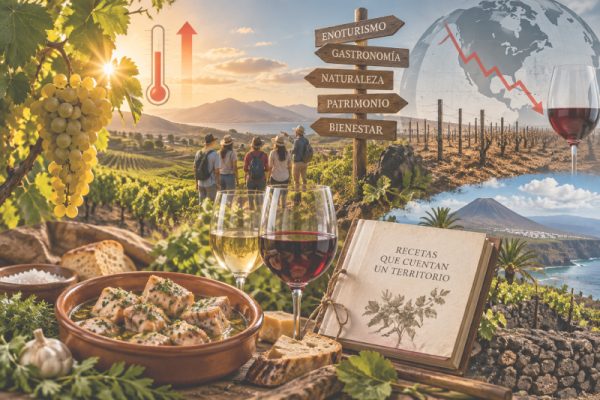
The world of wine is undergoing a period of change that is affecting vineyards, wineries and consumer habits alike. The last week of September has brought news that highlights some of the sector’s key trends: increasingly early harvests, greater focus on the origin of wines, diversification in wine tourism, and commercial difficulties in certain international markets.
At the same time, gastronomy continues to reconnect with the local area, locally sourced produce and traditional recipes. This development opens up new opportunities for regions such as the Canary Islands, where the unique character of the vineyards, native grape varieties and culinary heritage are key distinguishing features.
Climate change is altering the harvest schedule
The 2026 grape harvest once again highlights the influence of weather conditions on viticulture. The high temperatures recorded during the summer have brought forward the ripening of the grapes in many wine-producing regions, forcing wineries to adjust their harvesting schedules.
This phenomenon poses significant challenges for winegrowers and winemakers. Choosing the right time to harvest is crucial to achieving a balance between sugar levels, acidity and phenolic ripeness, particularly in areas where rising temperatures accelerate the vine’s growing cycle.
The situation is also prompting greater attention to be paid to the altitude of the vineyards, the orientation of the plots, soil management and the selection of grape varieties capable of adapting to changing climatic conditions.
For the Canary Islands, where wine-growing is characterised by an extraordinary diversity of altitudes, microclimates and traditional grape varieties, these issues take on particular significance. Adapting to climate change is emerging as one of the main challenges in ensuring the continuity of their wine-growing heritage.
The vineyard’s origin and identity take centre stage
Another trend that has characterised the week is the growing importance of origin as a distinguishing feature of wines.
One example is what has happened at national level with the recognition of three new ‘Singular Vineyards’ within the Rioja Qualified Designation of Origin, bringing the total number of vineyards in this category to 167.
This classification system makes it possible to highlight specific plots that meet certain criteria in terms of age, yield and quality, thereby strengthening the link between the wine and the region from which it comes.
The initiative reflects a trend that is also evident in other wine-producing regions: consumers keen to learn about wine are increasingly seeking information on vineyards, grape varieties, winemaking methods and the people behind each bottle.
In this context, designations of origin play an important role as tools for identifying, protecting and promoting wine-producing regions.
The Canary Islands boast a particularly unique heritage in this field. Their indigenous grape varieties, vineyards cultivated on volcanic soils, traditional training systems and the diversity of their wine-growing landscapes offer numerous opportunities to convey the character of their wines.
Wine tourism is seeking new ways to connect with consumers

Wine tourism continues to evolve towards experiences that go beyond traditional winery tours and tastings.
Throughout the week, there have been a series of events combining wine with gastronomy, historical heritage, outdoor activities, wellbeing and hands-on involvement in vineyard work.
Grape-harvesting experiences, tours of historic vineyards, wine tastings paired with regional cuisine and cultural activities bring the world of wine to audiences with a wide range of interests.
This diversification responds to a need within the sector: to forge new relationships with consumers and offer experiences that convey the cultural, scenic and human value of wine-growing.
For wineries, these proposals also represent an opportunity to generate additional economic activity, promote direct sales and contribute to the development of rural areas.
On our islands, where vineyards coexist with volcanic landscapes, protected natural areas and a cuisine with a distinct identity, wine tourism offers great potential for integrating various tourism and agri-food resources.
The fall in consumption is forcing a rethink of strategies
Whilst wine tourism initiatives are thriving, trends in consumption continue to be a cause for concern in some of the world’s leading wine-producing regions.
California has been at the centre of one of the week’s most significant international news stories. The decline in wine sales in the United States, the oversupply and the difficulties in marketing grapes are having a direct impact on the wine industry.
Some winegrowers are facing the need to reduce their vineyard areas, whilst certain wineries are reviewing their commercial strategies and business models.
This situation is due to a number of factors, including generational changes in consumption habits, competition from other drinks and changing consumer preferences.
The problem does not affect all regions or all categories of wine to the same extent, but it highlights the need to analyse the markets in greater depth and adapt supply to the new circumstances.
Differentiation, communication, the diversification of marketing channels and the search for new consumers are among the sector’s main areas of focus.
In this context, it is particularly important to convey effectively the value of the wine, its origin and the specific characteristics of its production.
Gastronomy is returning to its roots and championing local produce

This week’s culinary news has also highlighted the growing interest in traditional recipes, locally sourced produce and the revival of our culinary heritage.
In Tenerife, the 4th Tegueste Adobo and Wine Festival, scheduled for 10 October, is a prime example of this trend.
The initiative will bring together seven family recipes for adobo created by local residents, which can be sampled alongside local wines.
One of the new features of this year’s event will be the production, in collaboration with the Canary Islands Rural Development Agency, of a recipe book compiling the dishes presented during the various events.
The project will enable the documentation of culinary knowledge passed down through the generations and will help to preserve part of the municipality’s gastronomic heritage.
In a similar vein, events such as Orígenes Gran Canaria, which will take place on 28 and 29 September, place sustainability, biodiversity and regenerative gastronomy at the heart of the debate.
Although these two initiatives take different approaches, they share the same aim: to strengthen the links between food, producers, culture and the local area.
The Canary Islands and the opportunities presented by a sector undergoing transformation
The trends observed this week present challenges, but they also offer opportunities for the Canary Islands’ wine and gastronomy sector.
The archipelago boasts a combination of resources that may take on increasing importance in this new context: unique grape varieties, distinctive wine-growing landscapes, traditional cultivation techniques, high-quality agri-food products and a culinary tradition closely linked to its history.
Preserving this heritage, alongside adapting production systems to new climatic conditions, is one of the key tasks for the coming years.
At the same time, collaboration between wineries, restaurants, agri-food producers, institutions and tourism businesses can help to develop initiatives that bring local produce to the attention of both residents and visitors to the Islands.
The challenge is not simply to attract more customers, but also to ensure they understand the distinctive characteristics of the wines and food on offer.
Beyond the bottle: communicating the value of the region
A review of the past week reveals two seemingly contradictory trends. Whilst some of the major international markets are seeing a decline in wine consumption, new gastronomic, cultural and tourist experiences centred around wine are emerging.
This situation prompts us to reflect on the need to broaden the way in which the sector engages with society.
Wine is not just a drink. It also embodies agriculture, the countryside, history, knowledge, employment and food culture. Its ability to convey all these values can help to set products apart and forge stronger links with consumers.
For the archipelago, this development represents an opportunity to continue building a wine and gastronomy model based on the unique character of its regions, the protection of its agricultural heritage and collaboration between the various stakeholders in the sector.
The challenge in the coming years will be to ensure that consumers not only know about the wine they drink, but also about the region, the people and the culture that make it possible.